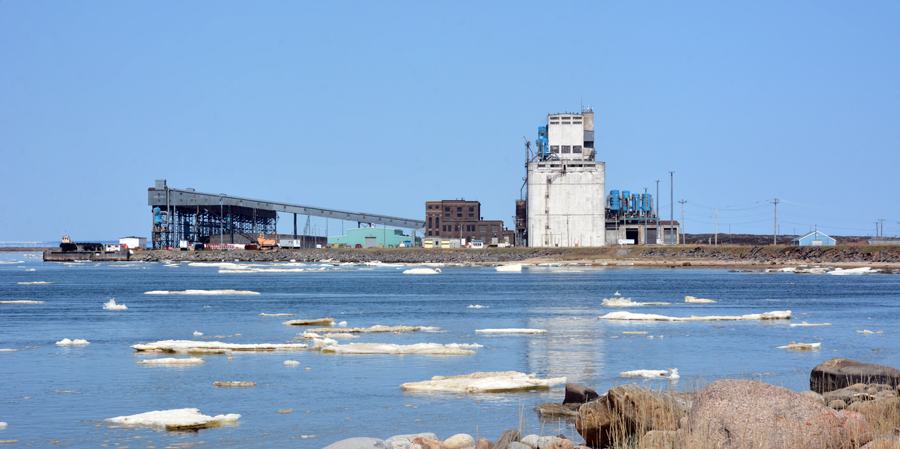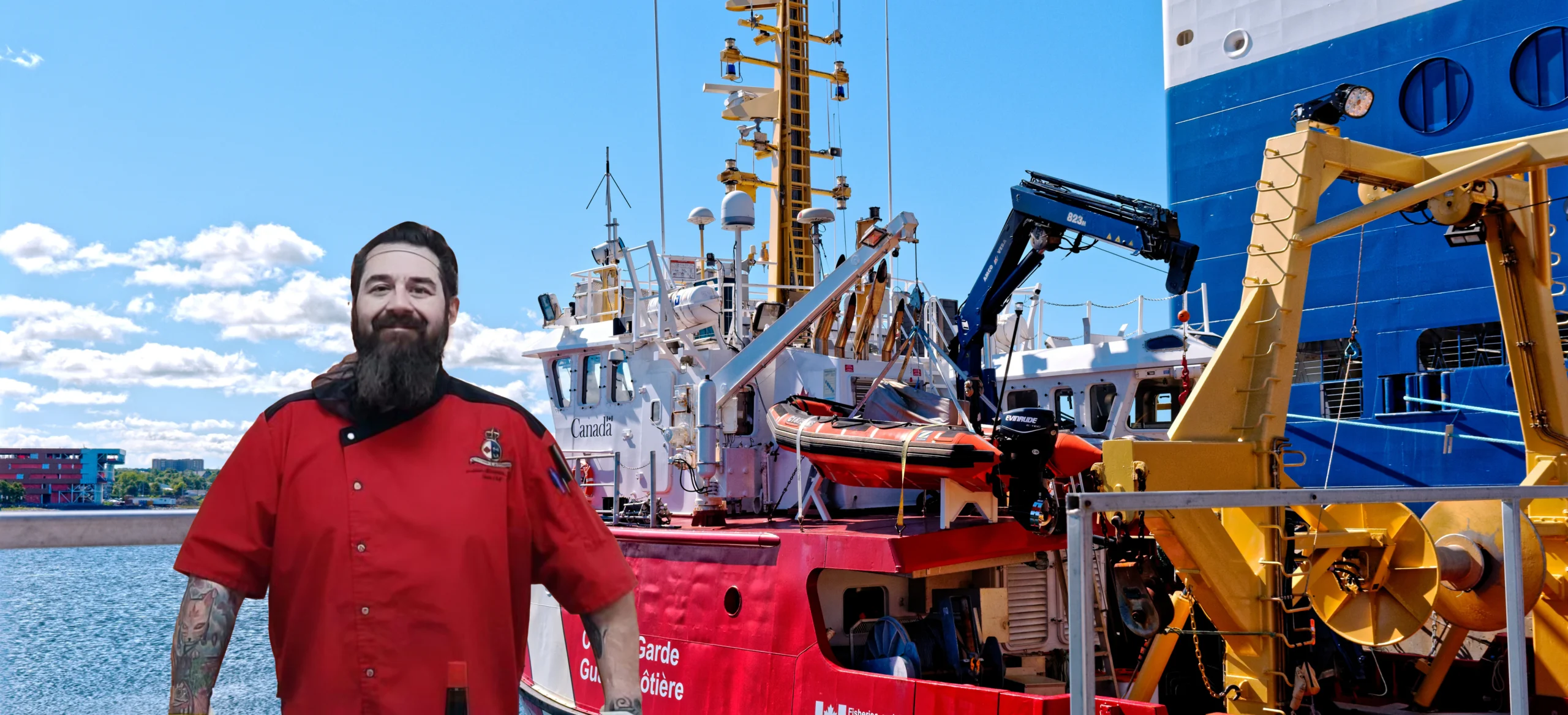

The Canadian Coast Guard Academy (formerly known as the Canadian Coast Guard College) sits on Point Edward, across the harbour from downtown Sydney, NS. It is the only training facility in the country for Navigators and Engineers in the Canadian Coast Guard (CCG). UCTE represents about 80 of the building’s staff.
Graham Alexander is Sous-chef at the Academy. He serves as President of Local 80831.
Growing up in the area, Graham was aware that the institution across the harbour was an important part of the local economy and social life. Like many locals, he didn’t know—on a practical level—what goes on in there.
It was later when he learned that this was a workplace where he could belong. Then later he learned that his uncle—who was the head engineer on the Bluenose II—had graduated from the College. It has deep roots in the community, but in a quiet way.
A Big Family to Feed
Now he’s been there thirteen years. He supervises a crew of thirteen in the kitchen, looking after cadets who come from all over the country. Asked to describe the pace, Graham compares it to “putting on three weddings a day.”
The family comparison goes beyond the busy pace. Our members and the other staff on site are guiding Cadets through a formative time in their lives, with true Cape Breton hospitality.
“Many of our cadets have never been out of their province, let alone all the way across the country—it’s a complete and utter culture shock.”
Cadets are resident at the institution for four years each. Many of them arrive at 18 or 19 years of age, and as at other educational institutions, deep bonds form. Socially, the academy is like a big family—”a 280-person family,” Graham is quick to qualify.
For example, several Coast Guard Cadets served at Graham’s wedding. Cadets run a relay around the Cape Breton trail each year and the whole academy community rallies around to keep the runners trained, hydrated, fed and supported. They see each other through the tough times too.
“People here have always been supportive,” says Graham, “but first I saw it through other peoples’ tragedies in their lives: car broke down, house burnt down, you know.” He was used to people putting each other up with places to stay, providing meals, and all the neighbourly kindnesses. Then it really came home for him when he came back from bereavement leave. He saw how his co-workers had gone the extra mile just to give Graham some space to transition back into work. Speaking about it, he’s deeply touched even years later.
Cape Breton Labour Heritage
In Canadian Labour History, Cape Breton Island has a mighty presence for its small population. Mining began in the area in the 18th century, in extreme conditions. Employers were monopolistic. Miners, steelworkers, and others had to organize to fight primarily for better wages and safety. Labour militancy peaked around a wave of strikes in the 1920s. Cape Breton workers are proud of that part of the local culture.
“We have a strong foundation of our union pride because we’re from Cape Breton,” says Graham. “We started the whole movement. In the Talking Union Basics course everybody says it started in the east. Yes, this this small little island is pretty much a labour giant.”
Nevertheless, the local has priorities that are familiar to local executives everywhere. Getting newer members to become active in the local; orientation; education and mobilization—these can still be challenges. It takes constant care and attention.
The 2023 PSAC strike came after a long period of labour peace. Many younger members had not seen that kind of mobilization before, and there was a big education task to do.
Putting it in Perspective
Graham notes, “People don’t realize what the unions have built for them. They say, ‘oh, I’ve got sick days, I’ve got my vacation, I’ve got all these things that are protected in my contract.’ But the reason they have those is because the unions before them fought, didn’t back down, and weathered the storm to gain them.”
For Graham, union activism is bigger than grievances and bargaining. It’s not always about conflict. “We don’t just say, we’re here in case something goes wrong. We’re also here for when things aren’t going wrong, and you want to grow or see something better.”