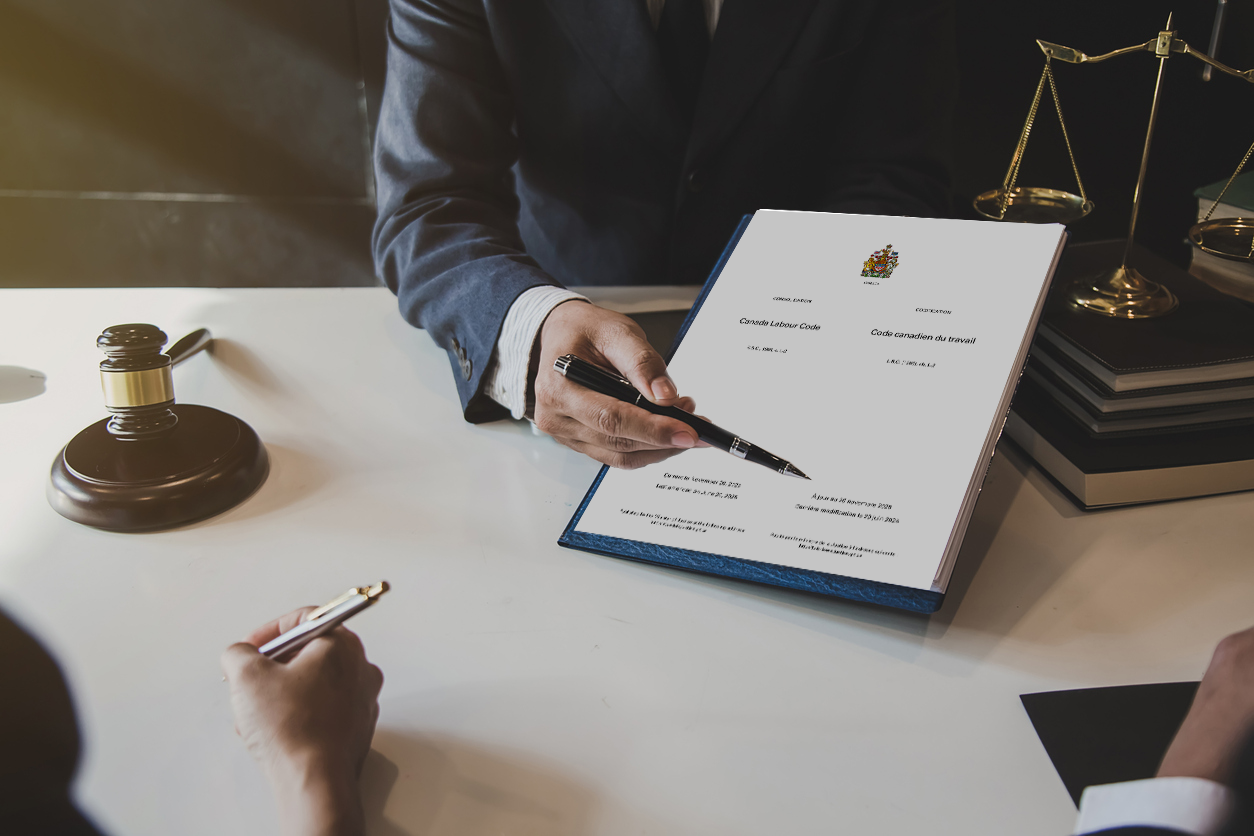

The use of “Section 107” of the Canada Labour Code (the Code) has been raised, and challenged, in several recent labour disputes. It’s been in the Code for decades, so why has it become a battleground this year?
The Basics
First principles first: The right to collective bargaining is only as good as the right to say no to a bad deal. If someone is offering you a price for your services, and they know you can’t walk away from the table, your power to negotiate is not much power at all.
Therefore, any limitation on the right to strike (or to take other job action) has the same undermining effect on collective bargaining. The government has its reasons for reserving the option to restrict the right to strike but these rationales are — and must continue to be — contested by the labour movement.
Section 107
The Code provides a clause that empower the Jobs Minister to infringe the right to strike “to maintain or secure industrial peace . . . as the Minister deems necessary.” This is apart from the option to introduce back-to-work legislation in Parliament. It was seldom used for a long time. Then, the Liberal government started using it more in 2024, first with port workers and then with railway workers.
The Canadian Industrial Relations Board made a ruling that it couldn’t be overturned, changing the whole playing field for workers in the federally regulated sector. It emboldened employers and the Jobs Minister began to use it regularly for expediency when facing pressure (mainly from employers) about inconveniences that come with job action.
When they do so, it’s in full knowledge that they’re infringing on our rights because they have placed some other interest (usually the economy) at a greater priority. That makes it our place to stand up and fight for our rights — or accept losing them.
Flight Attendants
This year the Jobs Minister invoked section 107 to order CUPE-represented Air Canada flight attendants back to work while Parliament was not in session.
The flight attendants and CUPE saw this as unjust and stood up against it. They kept bargaining and reached a tentative agreement after exercising their power this way. It’s the sort of victory that opens up more space for resistance.
Unions have also been challenging section 107 orders in the courts:
The Teamsters have applied for judicial reviews of the Minister’s use of s.107 against locked out rail workers in 2024. The Air Canada Component of CUPE has filed a Charter challenge demanding that s.107 be repealed. CUPW has also filed a Charter Challenge, and the Canadian Labour Congress raised a red flag last year after it was used against postal workers — for a fourth time in 2024 alone.
The federal NDP joined the opposition this year. If abuse of section 107 can be stopped, then at least violations of the right to strike would be subject to Parliamentary debate again. We demand full rights to free and fair collective bargaining, and certainly our democratically elected representatives should have a say when these rights might be infringed.
How might it affect UCTE members?
Many of our members are under Part I of the Code, but none of those have been directly affected by a Section 107 order — yet. It’s not applicable to Treasury Board members – currently in bargaining — because it’s in Part I, and those members’ collective bargaining is regulated by the Federal Public Service Labour Relations Act instead
Nonetheless, Parliament can order federal public service workers back to work. The last time this happened to PSAC members was in 1999.
Our members at airports, ports, and pilotage authorities are in federally regulated workplaces. Longshore workers in British Columbia and Montreal were forced into binding arbitration using section 107 last November. The government at the time cited the economic impact of the ports being closed. The danger is that our employers may also get the message that whether or not they bargain in good faith, the government could backstop them in the case of a strike or lockout.
But the issue is also a concern for all workers. Public and private sector workers alike have fought hard in the past for the right to strike. Trade unionists today have to continue to defend it.
Bypassing Democratic Process
When section 107[i] was used to send postal workers back to work in late 2024, the Minister used it hand-in-hand with section 108 to initiate an Industrial Inquiry Commission. The chain of events that followed will have unions very concerned.
The Commission’s mandate was not to reform the postal service but to examine the prospects for a negotiated collective agreement. However, it did included scope to examine the viability of the business.
The Commission’s report made recommendations about keeping the service financially viable.
Now the government intends to implement those recommendations. Section 107 set in motion an undemocratic digression from free collective bargaining that sidelines workers to impose arbitrary service cuts, threats, and uncertainty. Abuse of section 107 is undermining bargaining rights at a fundamental level. The recent agreements at CUPW were negotiated against the backdrop of those job cuts.
It’s a question of power now – will unions manage to defy and shut down section 107, or will the government continue to feel justified in using it, to the benefit of employers?
[i] The full text of the legislation is here: Canada Labour Code. Section 107 is here: Canada Labour Code It empowers the Jobs Minister to intervene. Section 108 empowers the Minister to create an Industrial Inquiry Commission to investigate and report back to the Minister.