September 29 is the anniversary of Estevan’s “Black Tuesday,” a dark day in the early history of labour organizing in the Prairies. Estevan, Saskatchewan was the site of deadly violence in a struggle for miners’ union recognition.
In 1931, the economic depression was leading more farm workers to seek work in the coal mines, which previously had been mostly seasonal work that agricultural workers used to supplement their income. Mining companies exploited their increasing desperation for work. Many of the workers lived in shoddy company housing and relied on a company store for basic needs. Miners’ unions were still early in their efforts to organize mine workers in the Prairies.
The workers joined the Mine Workers’ Union of Canada (MWUC), and demanded better pay, better workplace safety, ending the company store monopoly, and better living conditions.
The mining company would not recognize the union and refused to bargain. The workers began a strike on September 8, demanding recognition of the union.
Black Tuesday
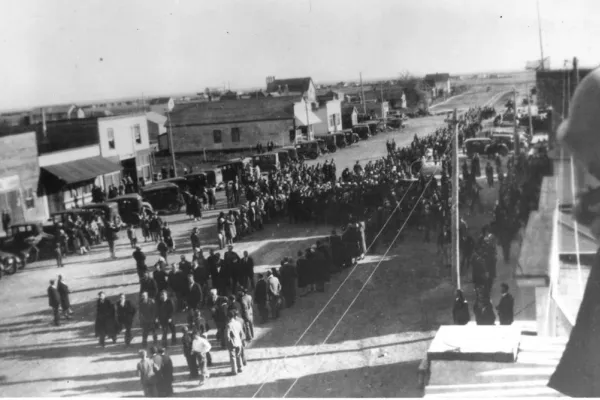
The RCMP confronted striking miners on day 24 of their strike, as they marched from Bienfait through Estevan to raise awareness. Tension between miners and police escalated to violence. Police opened fire, killing three miners and injuring others. The RCMP then continued to Bienfait and intimidated the community for two weeks (see Endicott article at the first link below).
Many of the local leaders and MWUC organizers were arrested and later charged with inciting a riot.
Read more of the history:
Bienfait: The Saskatchewan Miners’ Struggle of ’31 | History Cooperative
Estevan riot – Wikipedia
Estevan Coal Miners’ Strike 1931 | The Canadian Encyclopedia
Historic Designation
Earlier this year, the event was designated as an Event of National Historic Significance. Parks Canada calls the strike “emblematic of the deep divide between Canada’s struggling workers and company owners during the 1930s and the barriers to unionization.” Prior to this designation, it was commemorated by the Saskatchewan Federation of Labour.
Miners in Bienfait continued to organize and joined the United Mine Workers of America (UMWA) in 1938. They achieved their first collective agreement after the Co-operative Commonwealth Federation provincial government was elected in 1944. Today, an open-pit coal mine still operates in the area, where workers are still represented by the UMWA.